Address: 2404 E State St, Hermitage, PA 16148, United States
Phone Number: (724) 877-7380
Email Address: donkovac018@gmail.com
Business Hours:
Monday: 9:00 AM To 5:00 PM
Tuesday: 9:00 AM To 5:00 PM
Wednesday: 9:00 AM To 5:00 PM
Thursday: 9:00 AM To 5:00 PM
Friday: 9:00 AM To 5:00 PM
Saturday: 9:00 AM To 1:00 PM
Sunday: Closed
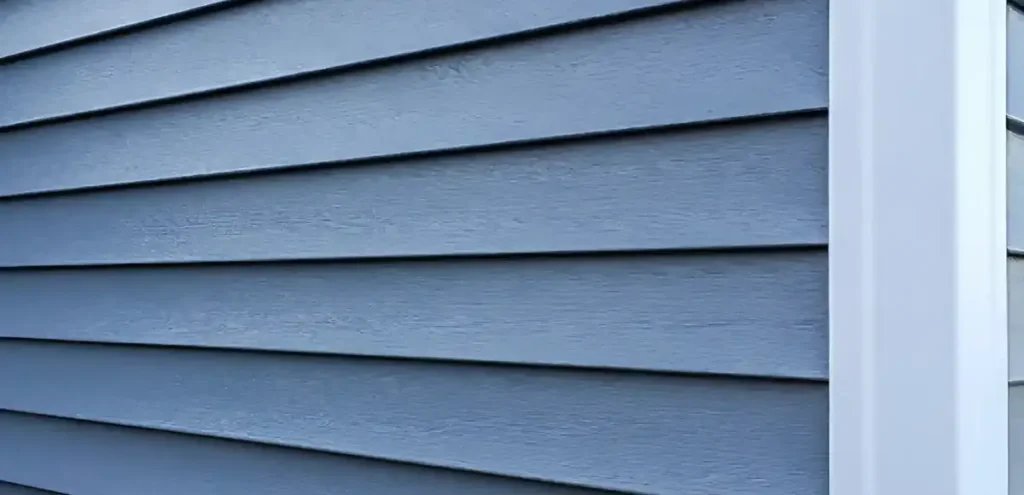
New siding does more than freshen up the look of a home. It seals the building envelope, blocks moisture, cuts heating and cooling costs, and protects framing from rot and pests for decades. At Big River Roofing, siding installation is one of our core specialties alongside residential roofing and gutter systems, and we install every panel ourselves with crews based out of Hermitage, PA.
Homeowners across Mercer, Lawrence, Butler, and Beaver Counties trust us to handle the full project from tear-off through finish trim. Whether you are replacing 40-year-old aluminum, upgrading after storm damage, or finishing new construction, we deliver a watertight, code-compliant install that pays for itself in curb appeal, energy savings, and resale value.
According to the latest Cost vs. Value Report, fiber cement siding replacement recoups roughly 88% of project cost at resale, and vinyl siding replacement recoups about 80%, ranking among the highest-return exterior remodels in the country. Few other home improvements pay back that aggressively while also lowering monthly utility bills.
Siding is the largest exterior surface on a house. It takes the brunt of wind-driven rain, UV radiation, freeze-thaw cycles, and impact from hail and debris. When it fails, the damage rarely stops at the surface.
Failed siding lets bulk water reach the sheathing, which leads to mold, rotted studs, ruined insulation, and eventually structural repairs that can cost five figures. The U.S. Department of Energy reports that air leaks and poor exterior envelope performance can drive 25% to 40% of a home’s heating and cooling load, and aging or improperly installed siding is a primary culprit. Replacing siding gives us the chance to add a continuous house wrap, flash every penetration correctly, and in many cases install a layer of rigid foam or insulated panels that can cut wall heat loss by 20% or more.
The exterior also drives first impressions. Real estate data consistently shows curb appeal and exterior condition rank among the top factors buyers weigh during walk-throughs, and outdated or visibly damaged siding is one of the fastest deal-killers on the market.
We are not married to one product line. We help every homeowner pick the material that fits their budget, climate exposure, architectural style, and long-term plans for the property. Below is a breakdown of what we install most often across western Pennsylvania.
Vinyl remains the most popular siding in America for good reason. It is affordable, comes in dozens of profiles and colors, never needs paint, and stands up well to Mercer County’s freeze-thaw winters. Modern insulated vinyl adds a layer of contoured EPS foam that boosts R-value, dampens sound, and resists impact damage. Premium lines from CertainTeed, Mastic, and Royal carry warranties of 30 years to lifetime and have proven performance in our climate.
Fiber cement, most commonly James Hardie, blends Portland cement, sand, and cellulose fibers into planks and panels that look almost identical to wood but resist fire, rot, termites, and warping. It carries a 30-year warranty, holds paint two to three times longer than wood, and is rated noncombustible by ASTM E136. Fiber cement costs more than vinyl up front but is the right call for homeowners who want maximum durability and a high-end aesthetic.
LP SmartSide and similar engineered wood products use treated wood strands bonded with resins to deliver the look of real cedar at a friendlier price point than fiber cement. Engineered wood ships are pre-primed, accept custom paint colors well, and are lighter to handle on the wall, which can shorten install timelines on large homes.
Vertical board and batten is having a major moment, especially on farmhouse and modern builds. We install both vinyl and fiber cement versions, often combining them with horizontal lap siding on lower stories for a layered, custom look that reads architectural rather than builder-grade.
Steel and aluminum siding suits modern, industrial, and agricultural-style homes and pairs naturally with our metal roofing installations. Metal panels resist fire, insects, and rot completely, and quality finishes hold their color for 30-plus years.
The right material depends on your budget, the look you want, and how long you plan to own the home. The table below summarizes the trade-offs between the four siding types we install most often so you can see where each one shines.
Material | Installed Cost (per sq ft) | Expected Lifespan | Maintenance | Best For |
Vinyl Siding | $4 – $12 | 25 – 40 years | Rinse annually; no paint | Budget-conscious homeowners, rentals, color variety |
Insulated Vinyl | $7 – $16 | 30 – 40 years | Rinse annually; no paint | Energy savings, impact resistance, sound dampening |
Fiber Cement | $10 – $20 | 50+ years | Repaint every 12 – 15 years | High-end finish, fire resistance, longevity |
Engineered Wood | $8 – $14 | 30 – 50 years | Repaint every 8 – 12 years | Real-wood look without cedar pricing |
Metal (Steel/Aluminum) | $9 – $18 | 40 – 60 years | Wash periodically | Modern designs, fire-prone areas, low-pitch builds |
Cost ranges reflect typical installed prices in western Pennsylvania including tear-off, house wrap, trim, and labor. Final pricing depends on home size, story height, and material grade.
Most siding failures we see on existing homes are not material problems. They are installation problems. Improper nailing, missing flashing, gaps at penetrations, and fasteners driven too tight all cause the same result, which is water finding its way behind the wall. Our process is built to eliminate every one of those failure points.
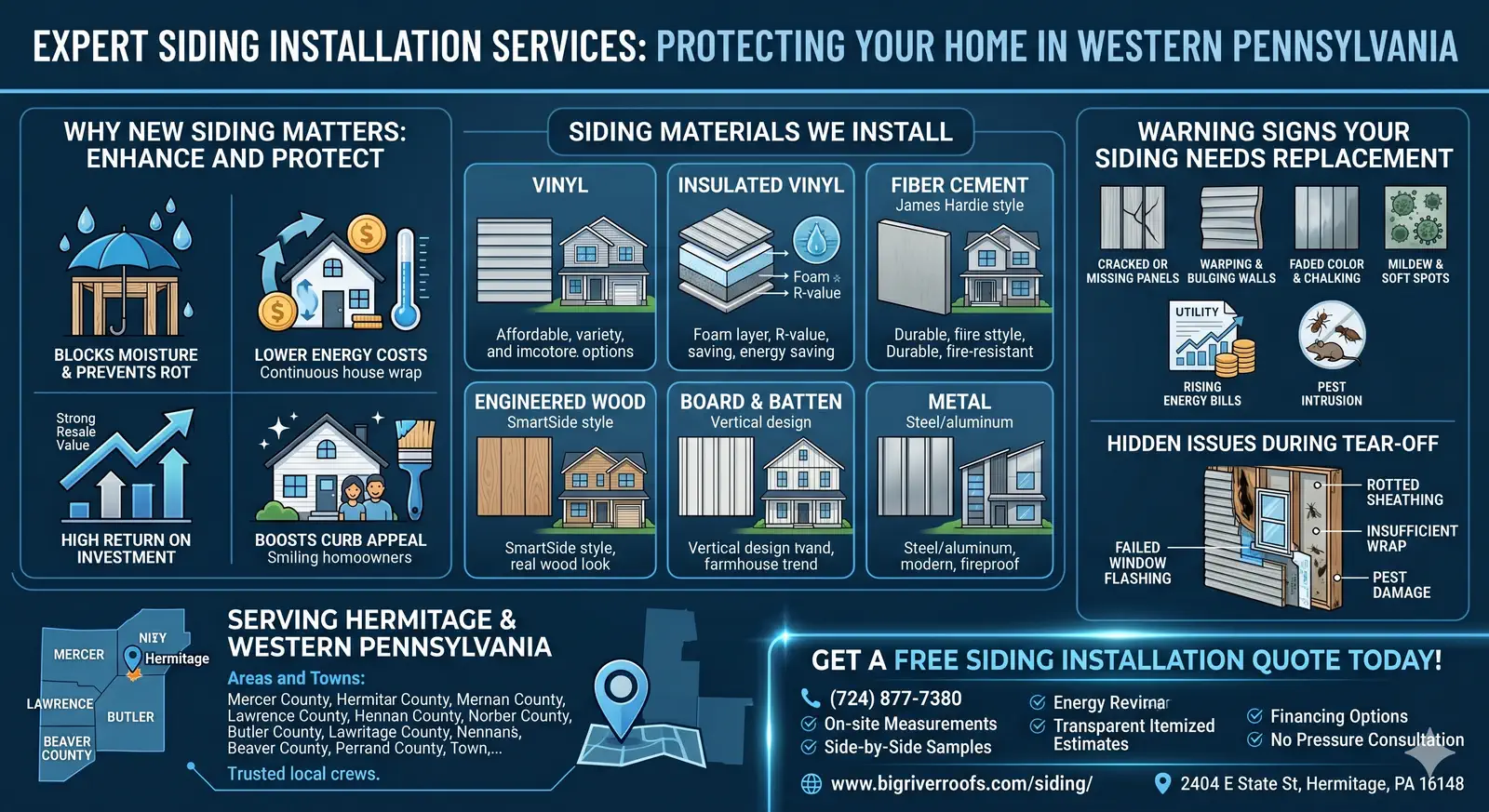
Pricing varies more than most homeowners expect because every house is different. A flat ranch with simple lines costs far less to side than a two-story Victorian with dormers, gables, and decorative trim. As a general benchmark, full siding replacement on an average 2,000 sq ft home in our service area runs roughly $14,000 to $32,000 installed, with vinyl on the lower end and fiber cement on the higher end.
Variables that move the number include the number of stories (two-story work requires more staging and labor), tear-off complexity, the presence of asbestos or lead paint requiring abatement, the amount of trim work, soffit and fascia replacement, accent features like board and batten or shake panels, and any sheathing repairs uncovered during tear-off.
Every quote we provide is itemized so you know exactly where your dollars are going. We also offer financing through approved lending partners, which lets many homeowners spread payments out without dipping into emergency savings. Visit our free quote page to start the estimate process.
Most siding does not fail all at once. It tells you it is on the way out for a year or two before the damage becomes urgent. Watching for these warning signs lets you plan a replacement on your timeline rather than reacting to an emergency.
Once siding comes off, we frequently uncover hidden conditions that need to be addressed before new material goes up. The table below outlines what we routinely find and how we handle it.
Condition | What It Looks Like | Our Response |
Rotted Sheathing | Soft, dark, or crumbling OSB or plywood | Cut out and replace with new sheathing matched to existing thickness |
Failed Window Flashing | Stained sheathing below window corners | Re-flash with self-adhered membrane and metal head flashing |
Insufficient House Wrap | Torn, missing, or improperly lapped wrap | Install full continuous weather-resistive barrier |
Pest Damage | Tunnels, nests, or chewed insulation | Treat, remove debris, and replace affected materials |
Old Aluminum or Asbestos Siding | Chalky residue or fibrous boards | Test, then dispose per EPA and PA DEP requirements |
Missing Insulation | Empty wall cavities or settled batts | Re-insulate or add rigid foam under new siding |
Any sheathing or framing repairs are documented with photos before close-in, and pricing for added work is approved in writing before we proceed.





Big River Roofing provides expert siding installation and replacement services to homeowners and property owners throughout the entire Western Pennsylvania service area. Our service areas include: Mercer County, Lawrence County, Butler County, Beaver County, Cranberry Township, Harmony, Wexford, Slippery Rock, Butler, Beaver, Grove City, New Castle, Neshannock, Mercer, Sharon, Hermitage, Ellwood City, West Middlesex, Beaver Falls, Warrendale and surrounding communities. Explore our complete list of coverage zones on our Service Areas page.
Whether you need new vinyl siding on a single-family home in Hermitage, fiber cement siding on a custom build in Cranberry Township, or storm damage siding replacement in Sharon, the team is locally based, manufacturer credentialed, and equipped to handle the full exterior envelope including roof, siding, and gutters under one contract.
You should not have to guess at what new siding will cost or which material is right for your home. Big River Roofing makes the decision easy with on-site measurements, side-by-side material samples, transparent line-item pricing, and a clear written scope you can compare against any other bid.
Call (724) 877-7380 or request your free quote online to lock in your spot on our installation calendar. Most quotes are completed within 24 to 48 hours, and there is never any pressure to move forward.
Address: 2404 E State St, Hermitage, PA 16148, United States
Phone Number: (724) 877-7380
Email Address: donkovac018@gmail.com
Business Hours:
Monday: 9:00 AM To 5:00 PM
Tuesday: 9:00 AM To 5:00 PM
Wednesday: 9:00 AM To 5:00 PM
Thursday: 9:00 AM To 5:00 PM
Friday: 9:00 AM To 5:00 PM
Saturday: 9:00 AM To 1:00 PM
Sunday: Closed
Full siding installation on a typical 2,000 sq ft home in western Pennsylvania runs roughly $14,000 to $32,000 installed. Vinyl is the most affordable option, fiber cement sits at the higher end, and engineered wood and metal fall in between. Tear-off, house wrap, trim, and any sheathing repairs are usually included in a complete quote.
Soft neutrals lead the market: warm whites, greige, sage and forest greens, deep navy, and classic black. Two-tone color schemes that pair a body color with contrasting trim, board and batten accents, or shake panels in the gables remain especially popular on farmhouse and modern builds.
We strongly recommend against it. Installing over old siding traps moisture, hides rot or pest damage, adds weight to the wall, and voids most manufacturer warranties. Proper installation always starts with a tear-off down to the sheathing.
In most cases, no, not directly. Stucco needs to be removed or thoroughly inspected and modified to accept furring strips, a weather-resistive barrier, and proper flashing. We evaluate each stucco home individually to determine the right approach.
Technically yes, practically no. DIY siding installation looks straightforward on YouTube but consistently produces leaks, buckled panels, voided warranties, and resale issues. Manufacturers like James Hardie and the Vinyl Siding Institute publish strict fastening, spacing, and flashing requirements that take experience to execute correctly. The cost of fixing a botched DIY install almost always exceeds the labor savings.
A single-story 1,500 sq ft home typically has 1,800 to 2,400 sq ft of exterior wall area depending on ceiling height and footprint. Two-story homes of the same interior square footage will have closer to 2,800 to 3,400 sq ft of wall. We measure every elevation directly to give you exact material counts.
Late spring through early fall is ideal in western Pennsylvania, but we install siding year-round. Vinyl becomes more brittle in extreme cold and needs to be handled and cut carefully below freezing. Fiber cement can be installed year-round without performance issues. We monitor the weather closely and plan accordingly.
Most full siding replacements on average homes take five to ten working days from tear-off to final cleanup. Larger or more detailed homes can run two to three weeks. Weather, scope changes, and material availability all influence the timeline.
Yes, in most cases. Combining new siding with a continuous house wrap and insulated vinyl or rigid foam under fiber cement can cut wall heat loss by 20% or more, which typically translates to 10% to 20% in heating and cooling savings depending on your starting point.
For more answers, visit our full FAQ page.
Your roof protects everything underneath it. If it’s been a few years since your last inspection, or a recent storm rolled through your area, now is the right time to get a professional set of eyes on it before a small problem becomes a costly one.
Reach out to Big River Roofing and let a certified local contractor give you a straight answer about what your roof needs. No sales pressure, no inflated estimates, just clear information and honest recommendations from a team that has been serving Hermitage and Western Pennsylvania homeowners for 5+ years.